WhatsApp:+86 13560808787
 moduo3201@gmail.com


Many people confuse stainless iron with stainless steel. In fact, stainless iron grades like SUS410, 420, and 430 are far more affordable than 304 stainless steel, yet they deliver solid performance in dry environments and mechanical manufacturing scenarios. This guide breaks down their compositions, applications, and selection tips, covering everything from 0.05mm ultra-thin strips to 3.5mm medium-thick sheets.
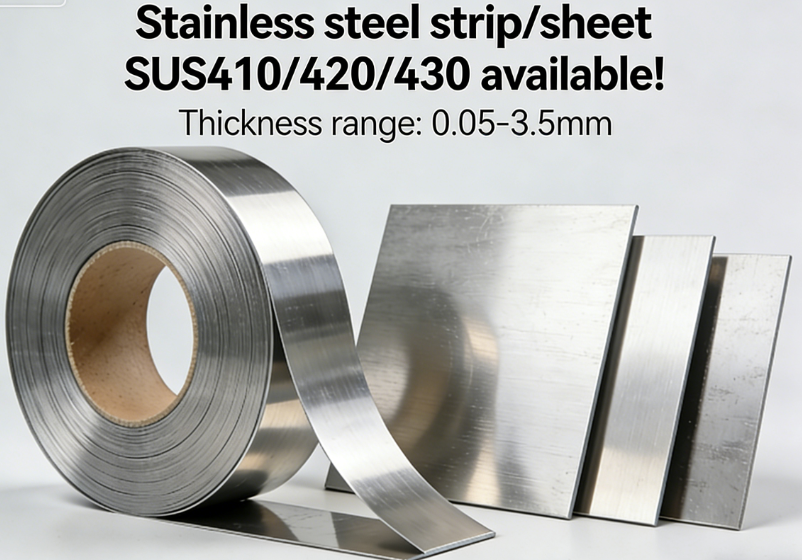
Core Parameter Comparison Table
| Item | SUS410 | SUS420 | SUS430 | Practical Tips |
|---|---|---|---|---|
| Thickness Range | 0.05–3.5mm | 0.05–3.5mm | 0.05–3.5mm | Ultra-thin strips (0.05–0.5mm) for precision parts; medium-thick sheets (0.6–3.5mm) for mechanical load-bearing |
| Core Composition | Cr 11.5–13.5%, C ≤0.15% | Cr 12–14%, C 0.15–0.4% | Cr 16–18%, C ≤0.12% | Higher carbon content = higher hardness: 420 > 410 > 430 |
| Magnetism | Strongly magnetic (firmly attracted to magnets) | Strongly magnetic | Strongly magnetic | Ideal for magnetic scenarios like electromagnetic components |
| Corrosion Resistance | Resists mild corrosion; rust-proof in dry environments | Slightly lower than 410; higher hardness | Best among the three; close to low-corrosion stainless steel | Not suitable for coastal or acid-base environments; only for dry indoor use |
| Mechanical Properties | Tensile strength ≥450MPa; mild bendable | Tensile strength ≥520MPa; hardness up to HRC50+ after quenching | Tensile strength ≥400MPa; better ductility than 410/420 | 420 for cutting tools; 430 for decorative parts; 410 balances strength and machinability |
| Surface Finishing | 2B matte, pickled, brushed | 2B matte, quenched & polished, brushed | 2B matte, BA bright, brushed | 420 polished for tool edges; 430 bright finish for decoration |
Key Differences Between SUS410/420/430
- SUS410: Balances Strength & MachinabilityA martensitic stainless iron with 11.5–13.5% chromium and ≤0.15% carbon. It can be hardened via quenching while retaining good bending and stamping properties in the annealed state. 0.05mm thin strips are ideal for small springs and clips; 3.5mm thick sheets work for agricultural machinery parts.
- SUS420: Hardness King for Tools & DiesHas the highest carbon content (0.15–0.4%) among the three, paired with 12–14% chromium. After quenching, its hardness exceeds HRC50, delivering sharp and wear-resistant edges. It’s commonly used for kitchen knives, scissors, and bearing races — 0.1mm thin strips can even be made into precision blades.
- SUS430: Best Corrosion ResistanceA ferritic stainless iron with the highest chromium content (16–18%) and ≤0.12% carbon. Its corrosion resistance tops the three grades, and it can be finished with bright or brushed surfaces for a premium look. 3.5mm thick sheets are used for range hood casings and oven liners; 0.05mm thin strips make decorative trim for home appliances.
Application Scenarios by Thickness
1. Ultra-Thin Strip (0.05–0.5mm)
SUS410: Iron cores for small electromagnetic relays, shrapnel for electronic components — strong magnetism + mild bendability ensure stable adsorption when energized.
SUS420: Razor blades, printer paper cutters — high hardness after quenching prevents edge rolling and ensures long service life.
SUS430: Refrigerator door trim, microwave liner patches — bright surface for aesthetics; rust-proof for 10+ years in dry environments.
2. Medium-Thin Strip (0.6–1.5mm)
SUS410: Auto exhaust brackets, motorcycle fenders — sufficient strength + lightweight design for structural parts.
SUS420: Tool bits for hardware, garden scissors — polished edges rival professional tool steel in sharpness.
SUS430: Oven liners, disinfection cabinet casings — heat-resistant and rust-proof; no deformation or rusting from high-temperature baking.
3. Medium-Thick Sheet (1.6–3.5mm)
SUS410: Agricultural plow blades, crusher hammers — wear-resistant and impact-resistant for outdoor dry environment operations.
SUS420: Mold inserts, bearing races — high hardness after quenching withstands high-frequency friction without wear.
SUS430: Security door frames, stair handrail bases — strong, easy to maintain, and perfect for indoor decoration.
Common Q&A
Q1: Are SUS410/420/430 stainless steel? Why are they called stainless iron?
Q2: Can these three stainless iron grades be used outdoors? Will they rust?
Q3: Which stainless iron grade is suitable for laser cutting? Is post-cutting treatment needed?
Q4: How to distinguish between these three grades? I’m afraid of buying the wrong type.
Hardness test: File the surface — SUS420 is the hardest (hard to file), SUS410 is medium, and SUS430 is the softest.
Check material reports: Verify chromium and carbon content — SUS430 has the highest chromium (16–18%), and SUS420 has the highest carbon (0.15–0.4%).
Q5: How do these three grades compare to 304 stainless steel in cost-effectiveness?
Next: None