WhatsApp:+86 13560808787
 moduo3201@gmail.com


Core Alloy Grades of Aluminum Alloy Profiles (By Series)
| Series | Representative Grades | Core Composition | Key Properties | Mainstream Applications |
|---|---|---|---|---|
| Series 1 (Pure Aluminum) | 1100, 1050, 1060 | Al≥99% | Excellent electrical & thermal conductivity, high ductility, low strength | Heat sinks, conductive busbars, food packaging, decorative components |
| Series 3 (Al-Mn Alloy) | 3003, 3004 | Al-Mn | Good rust & corrosion resistance, weldable, non-heat-treatable | Beverage cans, kitchen utensils, chemical containers, decorative panels |
| Series 5 (Al-Mg Alloy) | 5052, 5083, 5005 | Al-Mg | Medium-high strength, seawater corrosion resistance, excellent weldability | Shipbuilding, automotive parts, rail transit components, chemical storage tanks |
| Series 6 (Al-Mg-Si Alloy) | 6061, 6063, 6060 | Al-Mg-Si | Heat-treatable, easy to extrude, excellent surface finishability | Building doors & windows, industrial frames, assembly lines, furniture |
| Series 7 (Al-Zn Alloy) | 7075, 7005 | Al-Zn-Mg-Cu | Ultra-high strength, lightweight, aviation-grade performance | Aerospace components, drones, high-end mechanical structural parts |
Industrial Profile Models (Named by Cross-Section Side Length in mm)
1. Light-Duty Series (15/20/25 Series) — Low Load-Bearing, DIY/Small Equipment
| Series | Typical Models | Cross-Section Size (mm) | Load Capacity | Application Scenarios |
|---|---|---|---|---|
| 15 Series | 1515 | 15×15 | Extremely low | Small display racks, instrument shields, DIY small frames |
| 20 Series | 2020, 2040, 2060 | 20×20, 20×40, 20×60 | Low | 3D printer frames, small workbenches, protective doors, cabinet door frames |
| 25 Series | 2525, 2550 | 25×25, 25×50 | Low | Light-duty material racks, electronic equipment frames, small assembly lines |
2. Medium-Duty Series (30/40/45 Series) — Universal & Cost-Effective
| Series | Typical Models | Cross-Section Size (mm) | Load Capacity | Application Scenarios |
|---|---|---|---|---|
| 30 Series | 3030, 3060, 3090 | 30×30, 30×60, 30×90 | Medium | Workshop workbenches, material racks, equipment protective covers, medium assembly lines |
| 40 Series | 4040, 4080, 40120 | 40×40, 40×80, 40×120 | Medium-high | Industrial frames, heavy-duty workbenches, workshop fences, large equipment frames |
| 45 Series | 4545, 4590 | 45×45, 45×90 | Medium-high | Automation equipment, precision instrument frames, heavy-duty display racks |
3. Heavy-Duty Series (60/80/100 Series) — High Load-Bearing, Large Industrial Structures
| Series | Typical Models | Cross-Section Size (mm) | Load Capacity | Application Scenarios |
|---|---|---|---|---|
| 60 Series | 6060, 60120 | 60×60, 60×120 | High | Heavy-duty shelves, large equipment bases, industrial guardrails |
| 80 Series | 8080, 80160 | 80×80, 80×160 | Ultra-high | Super heavy-duty racks, large production lines, building auxiliary structures |
| 100 Series | 100100 | 100×100 | Ultra-high | Extra-large equipment, heavy-duty industrial platforms, special load-bearing structures |
Special-Shaped Profiles for Custom Needs
Round Tube Profiles: Outer diameter φ10~φ200mm, wall thickness 1~10mm — used for handrails, guardrails, transmission shafts, decorative columns.
Flat Bars/Angle Aluminum: Flat bars 10×2~100×10mm; Angle aluminum 20×20×2~100×100×10mm — used for edge wrapping, reinforcement, decoration.
U-Channel/Channel Aluminum: Channel width 10~80mm — used for guide rails, wire ducts, fixtures, decorative strips.
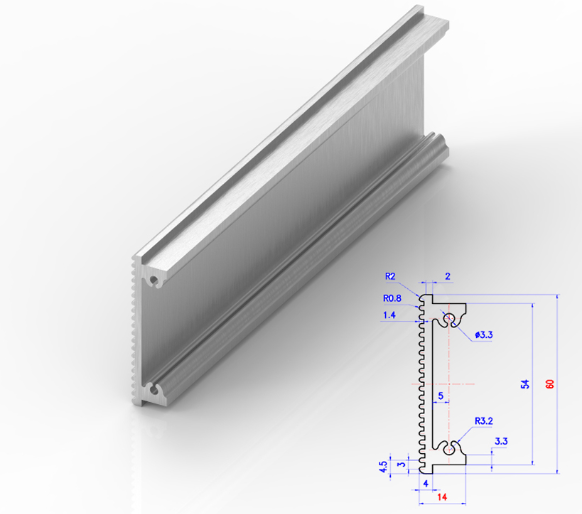
T-Profile/I-Profile: Used for heavy-duty structures, mechanical guide rails, load-bearing beams.
Custom Special-Shaped Profiles: Mold opening according to drawings, suitable for precision equipment, automotive, aerospace and other special structures.
Common Selection Q&A
- How to choose between 6061 and 6063 profiles?
6063: Excellent extrudability, bright anodized surface. Ideal for building doors & windows, decoration, light-duty frames. Best cost-performance ratio.
6061: Higher strength, superior weldability & corrosion resistance. Suitable for industrial structures, mechanical parts, load-bearing frames.
- What is the difference between European standard and national standard industrial profiles?The core difference is the slot size: European standard slots are 8mm wide, while national standard slots are 6mm wide. Accessories are not interchangeable — ensure consistency in standard when selecting.Cross-section naming rules are the same (e.g., 4040), and there is no essential difference in performance. Choose based on existing accessories.
- What is the difference between T5 and T6 temper profiles?
T5: Air-cooled quenching + artificial aging. Medium strength — commonly used for doors, windows, and decorative components.
T6: Water-cooled quenching + artificial aging. Higher strength — ideal for industrial load-bearing structures and mechanical components.
- How to select profiles based on load capacity?
Light load (≤50kg/m): Choose 2020, 2525 series.
Medium load (50~200kg/m): Choose 3030, 4040 series.
Heavy load (≥200kg/m): Choose 6060, 8080 and above series.
- How to choose surface treatment for aluminum profiles?
Anodizing: Wear-resistant, corrosion-resistant, with multiple color options (silver, champagne, black) — first choice for doors, windows, and decoration.
Powder Coating: Rich color options, strong adhesion — widely used for outdoor buildings and industrial equipment.
Electrophoretic Coating: Bright surface, excellent weather resistance — suitable for high-end doors, windows, and decorative parts.
'} Next:
Next: What Is the Density of Aluminum Plates?