Are you still troubled by burrs, severe deformation, and inability to cut complex patterns in stainless steel processing? In fact, you can easily solve these problems by choosing the right processing method! Stainless steel laser cutting, relying on the "light knife" cutting technology, accurately addresses many drawbacks of traditional processing. Let's take a look at its working principle and the solutions to your most concerned pain points.
First, Understand: What Exactly Is Stainless Steel Laser Cutting?
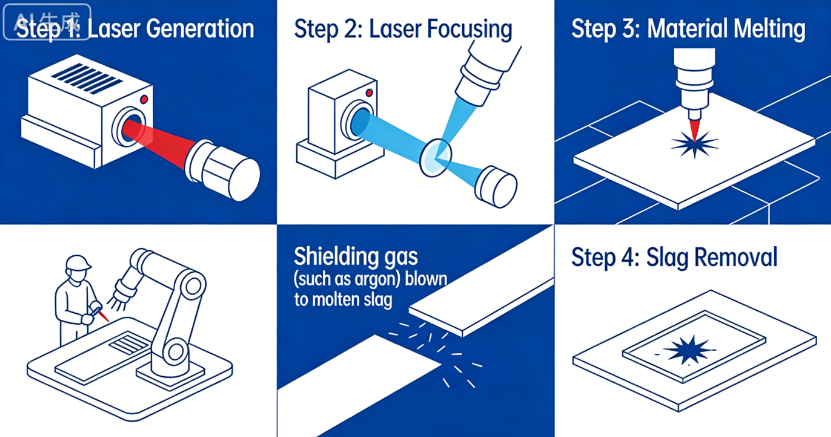
The core of stainless steel laser cutting is simple: using focused high-intensity light as an invisible knife to cut metal. The equipment emits a high-energy laser beam, which is focused into an extremely small spot with a diameter of less than 0.1 mm through an optical system. When this spot irradiates the stainless steel surface, it can raise the local temperature to tens of thousands of degrees Celsius within milliseconds.
High temperature causes the stainless steel to undergo "melting—vaporization" instantly, turning the hard metal into molten liquid or gas. At the same time, the equipment sprays high-pressure auxiliary gas (nitrogen and oxygen are commonly used), which blows away the slag and vaporized metal debris in time like blowing dust. As the laser beam and workpiece move along the preset path, smooth cuts can be precisely "engraved" to complete the cutting operation.
What's more impressive is that this "light knife" can be flexibly adjusted: changing the energy allows cutting thin strips of 0.1 mm to thick plates of 20 mm; adjusting the speed and spot size can control the smoothness of the cut; complex curves and small holes can be handled easily.
4 Major Pain Points of Traditional Processing, All Solved by Laser Cutting!
Excessive Burrs, Costly and Laborious Secondary ProcessingTraditional cutting leaves edges full of burrs, which require manual grinding. This not only increases costs but also affects the appearance and safety of products.Advantages of laser cutting: Laser energy is concentrated with narrow kerfs, resulting in smooth cross-sections. Burr-free cutting can be basically achieved for medium and thin plates, which can be used directly without additional grinding.
Severe Thermal Deformation, Poor Dimensional AccuracyStainless steel thin plates tend to warp and deform after processing, leading to workpiece scrapping or assembly difficulties, which is a major headache for many manufacturers.Advantages of laser cutting: Minimal and concentrated heat input results in an extremely small heat-affected zone. Coupled with the precise control of the cutting path by the CNC system, the flatness of the plate can be maintained to the greatest extent, with an accuracy of ±0.05 mm.
Difficult Processing of Complex Graphics, High Mold CostsFor small-batch production or complex pattern processing, traditional molds have high costs and long cycles, and it is also difficult to find suitable manufacturers.Advantages of laser cutting: No molds are needed. Direct cutting can be carried out after software drawing. Complex graphics and dense small holes can be perfectly reproduced, and small-batch orders can be quickly responded to.
Rough and Oxidized Cuts, Failing to Meet High-End RequirementsTraditional processes leave a lot of slag on the cuts with rough surfaces and even oxide layers, which cannot meet the requirements of precision components or appearance parts.Advantages of laser cutting: Using inert gases such as nitrogen for auxiliary cutting can avoid oxidation, and the cuts are clean and smooth, directly meeting the needs of subsequent processes such as welding and painting.
Key Process Parameters: The Core of Determining Cutting Effect
Want to achieve more stable laser cutting results? You must choose the right parameters:
Laser Power: For thin plates, select low power and high speed to avoid edge burning; for thick plates, choose high power and low speed to ensure cutting depth.
Auxiliary Gas: Choose nitrogen for oxidation-free cutting; choose oxygen for higher cutting speed; choose air if cost-sensitive (suitable for scenarios with low appearance requirements).
Focus Position: The best effect is achieved when the focus is slightly below the material surface. Specific adjustments should be made according to the plate thickness—even a deviation of 0.1 mm may affect the cutting quality.
Nozzle and Air Pressure: For 1-3 mm stainless steel, use a 1.5 mm nozzle with nitrogen pressure of 10-13 kg; for 5-6 mm stainless steel, use a 2.5 mm nozzle with pressure of 14-16 kg.
FAQ
Q1: Can laser cutting of stainless steel really achieve completely burr-free results?A: For medium and thin plates, with optimized parameters and suitable gas, the cross-section is almost burr-free and can be directly installed and used. Slight slag may appear at the corners of extremely thick plates, but the effect is far better than traditional processes.
Q2: What auxiliary gas is suitable for 3 mm thick 304 stainless steel?A: If it is a precision component or requires subsequent welding, choose nitrogen (oxidation-free); if you are not sensitive to the oxide layer and want to improve speed, choose oxygen; if the cost is limited and the appearance requirements are not high, air can be selected.
Q3: Will the cost increase significantly when cutting complex graphics with many small holes?A: The cost will increase slightly due to the piercing time, but without the need for molds, the overall cost is still lower than traditional processes, and the processing accuracy of small holes can be guaranteed.
Q4: What causes slight deformation of the plate after cutting?A: It is most likely due to incorrect focus position or unreasonable cutting path. You can appropriately increase the focus height, let the equipment optimize the cutting path, and disperse heat.
Q5: For small-batch proofing, how long can manufacturers usually deliver the goods?A: For conventional processes, delivery can be made within 1-3 days. For complex graphics or special requirements, you can communicate with the manufacturer in advance to confirm the specific delivery date.
Q6: How to solve the problem of yellowing and darkening of the cut?A: The main reasons are insufficient nitrogen purity or gas leakage. Check the nitrogen purity (it is recommended to be ≥99.9%), inspect whether the air pipe is leaking, and extend the purging time to clean the air pipe.
Choosing stainless steel laser cutting can not only solve many pain points of traditional processing, but also improve production efficiency and reduce comprehensive costs. If your processing needs involve specific plate thicknesses, complex graphics, or precision requirements, you might as well try this "light knife" cutting technology to take your product quality to a new level.
{eyou:prenext get='pre' empty='
Prev: None'}
Next:
Next: What Is Aluminum 1100?
 WhatsApp:+86 13560808787
 moduo3201@gmail.com