WhatsApp:+86 13560808787
 moduo3201@gmail.com


Pure Aluminum (Series 1)
Aluminum-Magnesium Alloy (Series 5)
Aluminum-Magnesium-Silicon Alloy (Series 6)
High-Strength Alloy (Series 7)
| Aluminum Plate Grade | Core Composition | Density (g/cm³) | Key Characteristics |
|---|---|---|---|
| 1060 (Pure Aluminum) | Aluminum content ≥99.6%, extremely low impurities | 2.71 | Excellent electrical & thermal conductivity, soft texture |
| 3003 (Al-Mn Alloy) | Aluminum + 1.0%-1.5% manganese | 2.73 | Strong corrosion resistance, high cost-performance ratio |
| 5052 (Al-Mg Alloy) | Aluminum + 2.2%-2.8% magnesium | 2.68 | High strength, seawater corrosion resistance |
| 5083 (Al-Mg Alloy) | Aluminum + 4.0%-4.9% magnesium | 2.66 | Super corrosion resistance, excellent low-temperature performance |
| 6061 (Al-Mg-Si Alloy) | Aluminum + 0.8%-1.2% magnesium + 0.4%-0.8% silicon | 2.70 | Comprehensive performance, heat-treatable for strengthening |
| 2024 (Al-Cu Alloy) | Aluminum + 3.8%-4.9% copper | 2.78 | Ultra-high strength, first choice for heavy industrial loads |
To put it simply: the density of pure aluminum plates is close to 2.71 g/cm³. Alloy plates with magnesium added have a slightly lower density, while those with copper or manganese added have a marginally higher density. However, all of them fall into the category of lightweight metal materials.
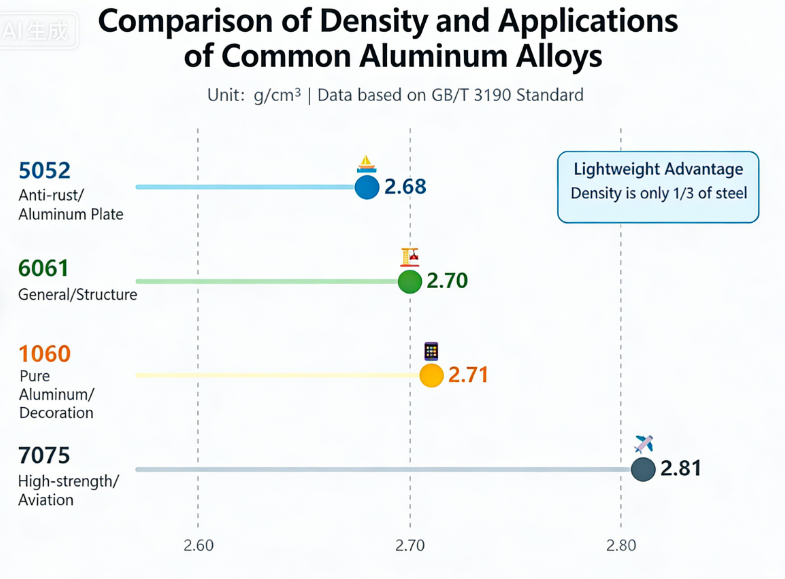
Composition Determines Performance! Which Scenarios Are Suitable for Aluminum Plates of Different Compositions?
- Pure Aluminum Plates (1060/1100)
Composition: Almost pure aluminum (≥99.0%) with few impurities
Density: 2.71 g/cm³, soft texture and good ductility
Common Scenarios: Heat sinks for electronic devices, food packaging, indoor decorative parts, electrical conductive components
Practical Cases: Heat sinks in mobile phone chargers and ceiling decorative panels in shopping malls are mostly made of 1060 aluminum plates, which are lightweight and easy to process.
- Aluminum-Manganese Alloy Plates (3003)
Composition: Aluminum + manganese elements, with 20% higher strength than pure aluminum
Density: 2.73 g/cm³, resistant to moisture and salt spray corrosion
Common Scenarios: Building roofs, cold storage equipment shells, advertising signs, battery casings
Practical Cases: The exterior walls of ordinary buildings in coastal areas use 3003 aluminum plates, which can withstand humid environments without rusting for 15 years.
- Aluminum-Magnesium Alloy Plates (5052/5083)
Composition: Aluminum + magnesium elements, with higher magnesium content leading to greater strength
Density: 2.66-2.68 g/cm³, lighter than pure aluminum and with top-tier corrosion resistance
Common Scenarios: Shipbuilding, coastal curtain walls, rail transit components, outdoor billboards
Practical Cases: The hull structures of medium-sized ships use 5083 aluminum plates, which are resistant to seawater corrosion and can reduce the weight of the hull.
- Aluminum-Magnesium-Silicon Alloy Plates (6061)
Composition: Aluminum + magnesium + silicon, can be strengthened through heat treatment
Density: 2.70 g/cm³, balancing strength, toughness and processability
Common Scenarios: Automotive body frames, aerospace structural parts, industrial machinery components, precision electronic casings
Practical Cases: The chassis components of new energy vehicles use 6061 aluminum plates, which can reduce the overall weight of the vehicle by 30% and increase the cruising range by 15%.
FAQ
- The density of aluminum plates is much lower than that of steel—can they provide sufficient strength?Absolutely! Although the density of aluminum plates is only 1/3 that of steel, alloy aluminum plates (such as 6061 and 5083) can meet the requirements of heavy industrial loads and building wind resistance by adding magnesium, silicon and other elements. Moreover, lightweight design can reduce transportation and installation costs.
- When selecting aluminum plates, which is more important: density or composition?Composition is the core! Density determines the lightweight level of aluminum plates, but composition directly affects corrosion resistance, strength and processability. For example, Series 5 aluminum-magnesium alloys should be selected for coastal scenarios (seawater corrosion resistance), and Series 6 alloys for industrial equipment (high strength). Do not ignore composition suitability just for density.
- Why do different aluminum plates have different densities?The main reason is the influence of alloying elements! Different alloying elements have different densities. For instance, magnesium has a lower density than aluminum, so Series 5 aluminum-magnesium alloy plates have a slightly lower density; copper has a higher density than aluminum, so Series 2 aluminum-copper alloy plates have a marginally higher density. However, the overall difference is small and does not affect the lightweight advantage.
- In daily procurement, how to quickly judge whether the composition of aluminum plates meets the standards?Three simple methods: ① Check the test report: Ask the supplier to provide a spectral test report to confirm that the composition matches the grade. ② Test flexibility: High-quality aluminum plates can be bent 90° without cracks or slag falling off. ③ Inspect the surface: Plates with uniform color, no oxidation spots and burr-free edges usually have purer composition.
- Is there a relationship between the density of aluminum plates and their thickness?No! Density is an inherent property of aluminum plates, and it has nothing to do with thickness or width. For example, a 1mm-thick 5052 aluminum plate and a 10mm-thick 5052 aluminum plate both have a density of 2.68 g/cm³. Thickness only affects the load-bearing and protective effects of the application scenario.
'} Next:
Next: None