WhatsApp:+86 13560808787
 moduo3201@gmail.com


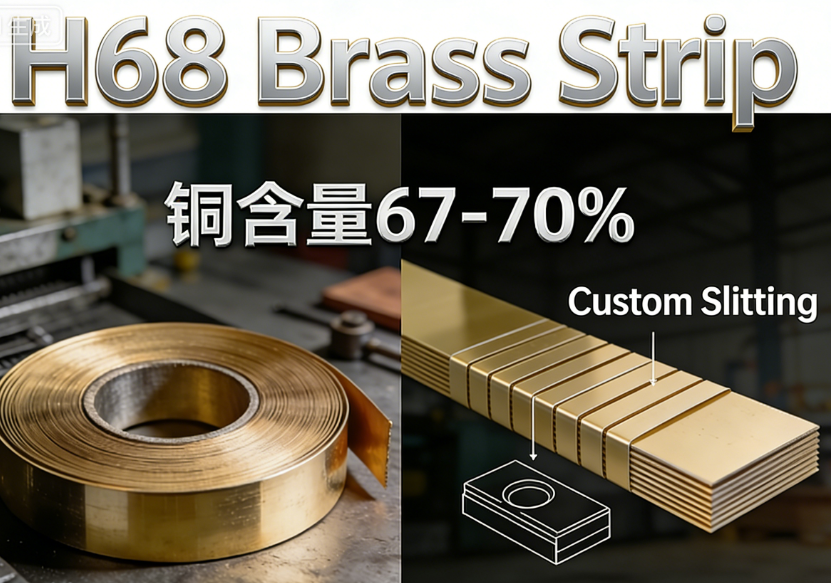
H68 brass strip is no ordinary brass alloy — it boasts a high copper content of 67-70%, with zinc as the balance element and strictly controlled impurities (Pb ≤ 0.03%, Fe ≤ 0.10%). This optimized composition makes it the most ductile grade among brass alloys. As professionals in industrial parts and decorative product manufacturing know, superior ductility means the material resists cracking during bending, stretching, and deep drawing processes. It handles complex applications like intricate electronic component housings and jewelry prototypes with ease. Additionally, it offers good electrical and thermal conductivity, along with better corrosion resistance than regular carbon steel, ensuring long service life without rusting in daily environments.
| Thickness Range | Core Features | Typical Applications | Processing Recommendations |
|---|---|---|---|
| 0.05-0.3mm | Ultra-thin, highly formable, excellent flexibility | Jewelry prototypes, electrodes for electronic components, gaskets for precision instruments | High-precision laser cutting available; slitting width customizable down to millimeter scale |
| 0.3-1.0mm | Balanced ductility & strength, easy to weld | Relay terminals, automotive sensor housings, decorative frames | Complex patterns can be directly laser-cut without secondary polishing |
| 1.0-2.0mm | High strength, good wear resistance | Mechanical gears, valve seals, heat sink bases | Can be directly processed after slitting, ideal for mass production |
Application Scenarios of H68 Brass Strip
Electronics & Electrical Industry: Relays, switches, connectors, and heat sinks — leveraging its excellent electrical/thermal conductivity and machinability.
Decoration & Hardware: Gift box buckles, bathroom accessories, medals, and badges — offering a premium look with no rust or fading.
Automotive & Machinery: Automotive sensors, valve seals, and low-speed bearings — meeting strict strength and wear resistance requirements.
Aerospace: Precision instrument components and conductive rings — its high ductility and stability fit the industry’s rigorous demands.
Handmade DIY Projects: A favorite among crafters for making earrings and pendants. The 0.1mm thickness is perfect for rolling into thin loops and easy shaping.
FAQ
Q: What’s the difference between H68 brass strip and regular brass?
Q: Does H68 brass strip need secondary polishing after laser cutting?
Q: Will 0.05mm ultra-thin H68 brass strip warp during laser cutting?
Q: Can H68 brass strip be used in humid environments like coastal areas?
Q: How precise is the slitting width? What’s the minimum width available?
Next: In-Stock H70 Brass Strip 0.05-2.0mm Full Range | One-Stop Laser Cutting & Slitting Service