WhatsApp:+86 13560808787
 moduo3201@gmail.com


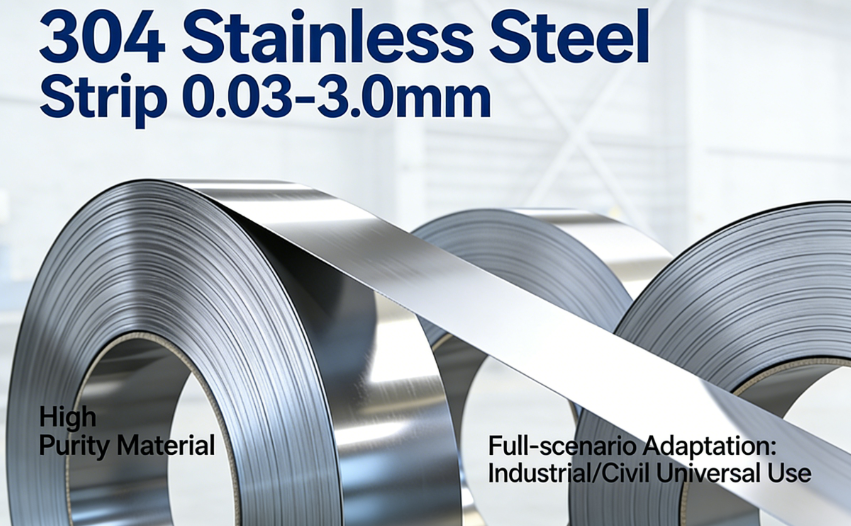
304 stainless steel strip has become a versatile "all-rounder" material thanks to its solid composition. Its core elements are chromium and nickel, a "golden combination" for rust resistance: chromium forms a dense oxide film on the surface, like an invisible protective coat that blocks moisture and acid-base corrosion; nickel enhances the material’s toughness and ductility, preventing it from breaking during stretching, compression, or bending.
Core Specification Table
| Item | Detailed Parameters |
|---|---|
| Thickness Range | 0.03–3.0mm |
| Core Composition | Cr: 18.0%–20.0%, Ni: 8.0%–10.5% |
| Surface Finishes | 2B (matte), BA (bright), brushed, 8K mirror |
| Mechanical Properties | Tensile strength ≥520MPa, elongation ≥40% |
| Corrosion Resistance | Salt spray test ≥48 hours without rust |
Application Scenarios by Thickness
- Ultra-Thin Strip (0.03–0.1mm)Ideal for mobile phone shielding cases and smart watch straps. The 0.03mm ultra-thin strip can be laser-etched to create complex micro-holes, with an electromagnetic shielding effectiveness of ≥80dB — it’s commonly used as the signal shielding layer inside mobile phones.
- Thin Strip (0.1–0.5mm)Widely used in power battery casings and medical surgical instruments. CATL’s battery casings adopt 0.15mm nickel-plated 304 strip, which has 5x better corrosion resistance than galvanized steel and reduces weight by 15%.
- Medium-Thin Strip (0.5–1.5mm)The core material for home appliances and food machinery. Air conditioner radiators and refrigerator inner liners use 0.8mm 2B-finish strip, which ensures uniform heat conduction and oil resistance; food filling equipment uses 1.0mm FDA-certified strip, with a smooth surface that resists bacterial adhesion and is easy to clean.
- Medium-Thick Strip (1.5–3.0mm)Essential for industrial equipment and building structural parts. New energy bus frames use 2.0mm high-strength 304 strip, with a tensile strength of ≥1100MPa — it reduces weight by 30% compared to traditional carbon steel and has a service life of up to 20 years. It’s also commonly used for equipment protective covers and chemical pipeline gaskets in workshops, thanks to its impact resistance and corrosion resistance.
Common Q&A
Q1: What is the difference between 304 and 304L stainless steel strip? How to choose?
Choose 304L if the product requires welding (e.g., pipelines, equipment frames) — it prevents intergranular corrosion after welding.
Choose 304 for general scenarios — it offers better cost-effectiveness.
Q2: How to identify genuine 304 stainless steel strip?
Ask for an SGS or spectral analysis report and check if the chromium and nickel content fall within the standard range.
Test with a magnet — genuine 304 is almost non-magnetic; strong magnetism indicates it’s likely 201 stainless steel passed off as 304.
Inspect the surface — scratch the outer layer; genuine 304 is silvery white throughout, with no delamination or blackening.
Q3: Can 304 stainless steel strip be used outdoors? Will it rust?
Q4: What are the different uses of 304 stainless steel strip with various surface finishes?
2B finish: Matte grayish-white, suitable for industrial equipment and pipelines — cost-effective.
BA finish: Bright and flat, commonly used for home appliance panels and decorative parts.
Brushed finish: Uniform texture, scratch-resistant — ideal for elevator panels and kitchen utensils.
8K mirror finish: High reflectivity, strong decorative effect, but prone to fingerprints — requires regular maintenance.
Next: Supply of 316 Stainless Steel Strip/Sheet - Laser Cutting Service Available