N6 pure nickel strip/sheet, with its ultra-high purity of over 99.6% and excellent processability, has become a core material in new energy batteries, high-end electronics, and chemical equipment fields. Whether it’s 0.01mm ultra-thin foil or 1.0mm thick sheet, combined with laser cutting and slitting processes, it can accurately meet all your design needs.
This guide will take you through the performance, core application scenarios of N6 material, and how to utilize modern processing technologies.
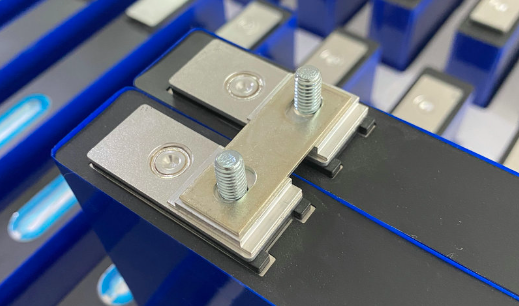
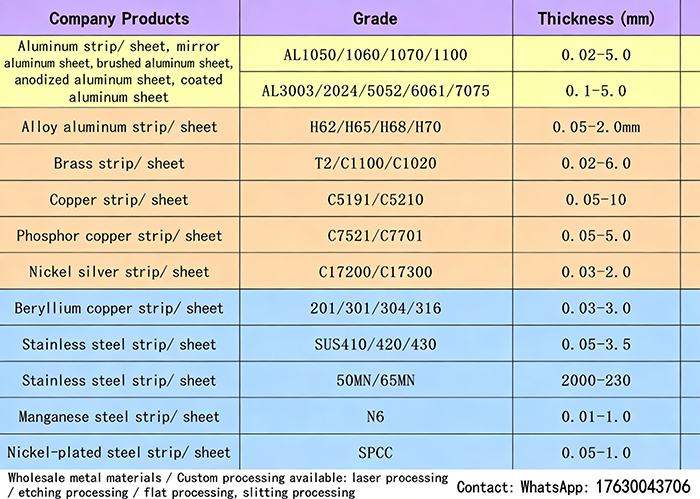
The code "N6" reveals its core identity — a high-purity pure nickel material. Here, "N" stands for Nickel, and "6" corresponds to the grade in China’s national standard GB/T 2054, requiring the total content of nickel + cobalt to be no less than 99.5%. In actual production, high-quality N6 material can reach a purity of 99.6% or even 99.8% and above.
This ultra-high purity endows N6 with a series of outstanding properties:
Excellent Electrical & Thermal Conductivity: As a "top performer" among metals, N6 is an ideal choice for manufacturing battery tabs and circuit components, which can greatly reduce energy loss.
Strong Corrosion Resistance: It has excellent resistance to various acids, alkalis, and marine environments, making it highly favored in chemical equipment and marine engineering.
Superior Ductility & Weldability: Good plasticity and cold working performance make it easy to stamp and weld, providing possibilities for complex structural designs.
Core Application Scenarios & Advantages
| Application Field | Specific Uses | Core Advantages |
|---|
| New Energy Batteries | Tabs and connectors for lithium batteries, nickel-metal hydride batteries | Low resistance, excellent weldability, improves battery pack efficiency and safety |
| Electronic Manufacturing | Integrated circuit lead frames, shielding cases, contacts | High conductivity, corrosion resistance, ensures long-term stability of precision devices |
| Chemical Equipment | Reactor linings, heat exchanger tube sheets, instrument components | Excellent acid and alkali corrosion resistance, extends equipment service life |
| Electroplating & Anodes | Electroplating anodes, special electrolytic electrodes | High purity ensures uniform and durable electroplating quality |
Precision Processing Services
A high-quality N6 raw material can be turned into qualified parts only through precision processing.
1. Laser Cutting
We use high-precision fiber lasers, no mold opening required, zero mold cost. It is especially suitable for processing small-batch, multi-variety, and complex-shaped parts, with smooth and burr-free cut edges.
2. Slitting Processing
Wide nickel coils are cut into narrow strips of specific widths through precision slitting machines. The thickness range you need (0.01–1.0mm) is exactly the typical application range of slitting processing, which can efficiently produce strip products such as battery tabs.
When choosing a supplier among many on the market, in addition to focusing on purity (it is recommended to request a material report) and dimensional accuracy (thickness and width tolerance), the supplier’s processing capability is the key. A qualified supplier should be able to provide one-stop customized services from raw materials to laser cutting, slitting, and even bending and welding.
Common Q&A
Q1: What is the difference between N6 and N4 pure nickel?
A1: The main difference lies in nickel content. N6 requires nickel + cobalt content ≥99.5%, while N4 requires ≥99.9%. N4 has higher purity, theoretically better conductivity and corrosion resistance, but also higher cost. N6 can fully meet the requirements of most industrial applications and has higher cost-effectiveness.
Q2: Can 0.01mm ultra-thin nickel strip be used in practice?
A2: Absolutely. Ultra-thin nickel strips (0.01–0.05mm) usually exist in the form of foil, mainly used in microelectronic components, precision sensors, or high-end scientific research fields with extreme requirements for space and weight. Its processing requires extremely high rolling technology and tension control.
Q3: Should I choose laser cutting or traditional stamping?
A3: Laser cutting is suitable for complex graphics, small batches, and rapid prototyping, with high flexibility and no mold cost. Traditional stamping is suitable for simple shapes and mass production, with high efficiency and low unit cost, but requires mold opening. If your parts have complex shapes or need frequent design revisions, laser cutting is a better solution.
Q4: How to judge the quality of N6 material?
A4: Four key checks:
Check material certificate: Regular suppliers should provide material certificates that comply with standards such as GB/T 2054 or ASTM B162.
Check surface quality: The surface should be bright, uniform, free of oxide scale and scratches.
Check dimensional accuracy: Verify whether the thickness and width tolerances are within the promised range.
Check processability: Test whether it is easy to crack during processing and whether the welding is firm.
Prev: None Next: Nickel-Plated Steel Strip/Sheet SPCC | 0.05–1.0mm Thickness Range
 WhatsApp:+86 13560808787
 moduo3201@gmail.com